Great Sand Dunes National Park Guide: Sandboarding, Medano Creek & Stargazing
Nomad Toolkit
Overview & Vibe
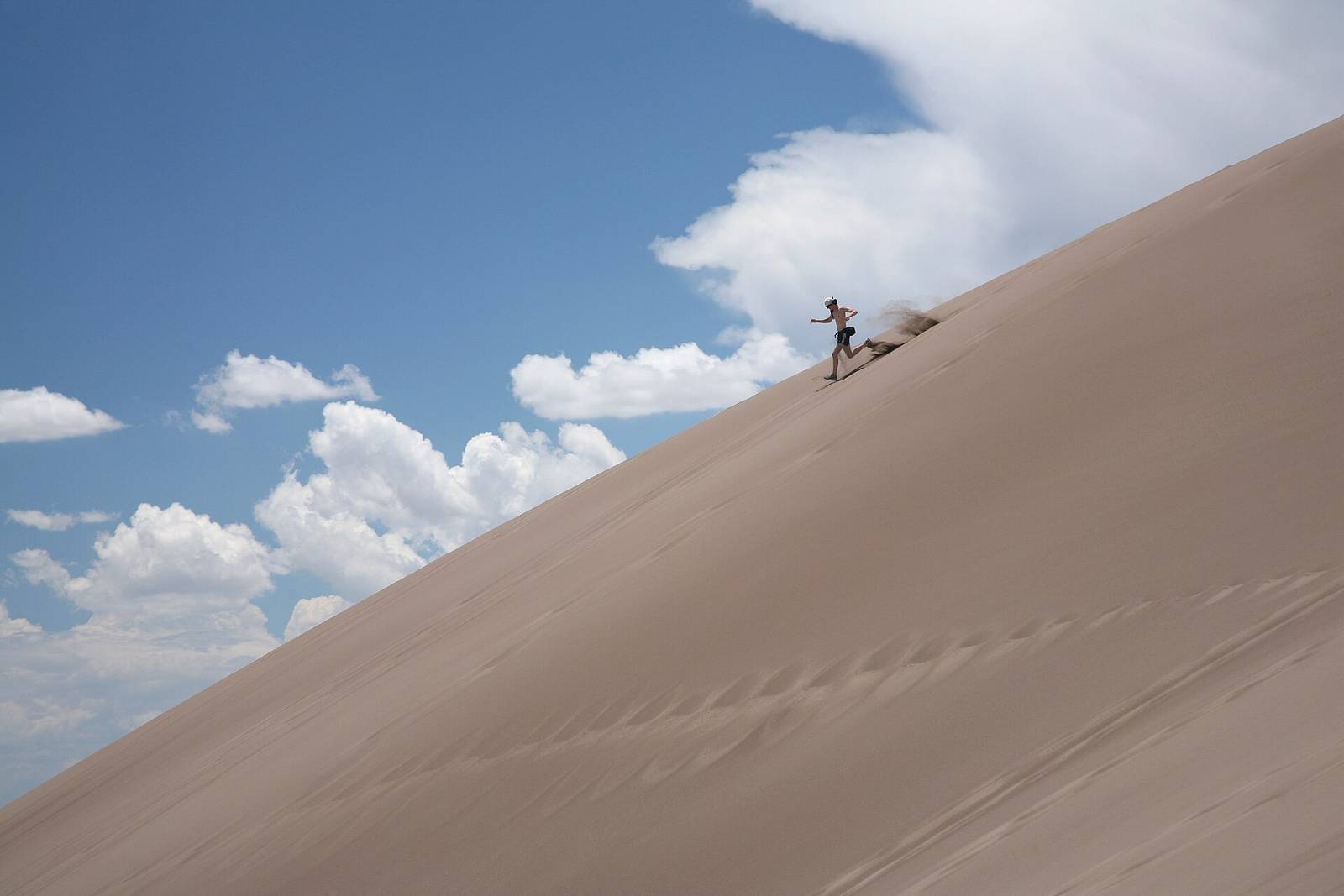
Great Sand Dunes National Park and Preserve protects 149,028 acres in Colorado's San Luis Valley, including the tallest dunes in North America. Star Dune rises about 750 feet, and the dune field covers roughly 30 square miles at about 7,700 feet. The park logged 432,498 recreational visits in 2025, a fraction of Grand Canyon's crowds.
The appeal is the contrast: a sand sea backed by the 13,000-foot Sangre de Cristo Mountains, a seasonal creek at its base, and an International Dark Sky Park designation since 2019. There are no marked trails on the sand, so you pick a ridge and climb.
A Brief History
People have lived in the San Luis Valley for about 11,000 years, and the Ute name for the dunes means "sand that moves." Zebulon Pike described the dunes in his 1807 journals. Local women of the P.E.O. Sisterhood campaigned in the 1920s to stop gold mining on the sand, and President Hoover created a national monument in 1932. It became a national park and preserve on September 24, 2004 (Wikipedia).
Transportation
A car is close to essential. Per the park service, the Visitor Center is 37 miles from Alamosa, 167 miles from Colorado Springs, 184 from Santa Fe, 234 from Denver via US 285 and 246 from Albuquerque. From I-25, take US 160 west at Walsenburg, then CO 150 north. Alamosa has a small airport with commercial service; Denver, Colorado Springs and Albuquerque have far more flights and rental cars.
The park has no shuttle. The paved road ends at the dunes parking area and Piñon Flats Campground. Beyond that, the Medano Pass Primitive Road needs high-clearance 4WD, and an air pump at the Visitor Center lets you reinflate tires after the sand.
Language, Customs & Etiquette
English is the working language, and you will hear Spanish in valley towns. Blanca Peak to the south is sacred to the Navajo, who call it Sisnaajini. Pack out all trash and give other hikers space on narrow ridgelines.
Safety & Security
Heat and altitude cause most problems. In summer, sand surface temperatures can pass 140 F by midday, so start hikes at dawn and wear closed shoes. Afternoon thunderstorms are common from July to September, and a high dune ridge is a bad place to be when lightning starts. Carry more water than seems sensible, since you are working hard at 8,000 feet in dry air. Tell someone your route before heading toward Star Dune, because the sand has no trail markers and ridges look alike.
Weather & Climate
The table shows 1991 to 2020 NOAA averages at the park's own station, per Wikipedia. Annual precipitation is only about 12 inches. Late April and October bring mild days and thinner crowds; nights below freezing are normal from October through April.
| Month | High F | Low F |
|---|---|---|
| Jan | 33 | 11 |
| Feb | 39 | 16 |
| Mar | 49 | 24 |
| Apr | 56 | 29 |
| May | 66 | 38 |
| Jun | 77 | 48 |
| Jul | 81 | 52 |
| Aug | 78 | 50 |
| Sep | 72 | 44 |
| Oct | 60 | 33 |
| Nov | 46 | 22 |
| Dec | 34 | 12 |
Logistics & Practical Info
- Entrance: $25 per private vehicle, $20 per motorcycle, $15 per person on foot or bike (16 and older), valid 7 days.
- Passes: Great Sand Dunes annual pass $45; America the Beautiful $80 for US residents, $250 for non-residents.
- Remaining 2026 fee-free days for US residents: October 27 and November 11.
- The park is open 24 hours, all year. The Visitor Center is open 9 am to 4:30 pm daily except Thanksgiving, Christmas and New Year's Day.
- Piñon Flats Campground runs April through October. Car camping is not allowed in the park November through March.
- Medano Pass Primitive Road opens late spring through fall, conditions permitting.
- No sandboard rentals inside the park. Full groceries are in Alamosa, 38 miles southwest.
Attractions & Activities
Top Sights
- Medano Creek: flows past the main parking area from late April through late June, peaking late May to early June, with surge waves about every 20 seconds. Dry by fall.
- Sandboarding and sledding: rent outside the park. The Ramble canteen at Ramble at the Great Sand Dunes lists full-day sand boards at $25, and Dune Valley Distillery in Mosca rents boards too (Thursday to Saturday, 2 to 8 pm).
- Stargazing: a certified Dark Sky Park. Walk onto the dunes after moonset and skip the flashlight.
Hikes
- High Dune: about 2.5 miles round trip on soft sand. Budget an hour per mile.
- Star Dune: about 6 miles round trip to the tallest dune in North America. Start at sunrise.
- Mosca Pass Trail: about 7 miles round trip through aspen and evergreen to the 9,737-foot pass. The best shade in the park.
- Zapata Falls: a Bureau of Land Management site south of the park, about 1 mile round trip with 200 feet of gain, at the end of a rough 3.5-mile dirt road off CO 150.
Where to Eat
Food is thin near the park. The Ramble canteen in Mosca sells a barbacoa beef Bonfire Burrito for $8.50 and a s'mores kit for four at $9.50. The park lists the Oasis restaurant at the entrance as seasonal, typically May through September, and Lu's Main Street Cafe in Blanca and Del's Diner in Fort Garland as year-round options. Alamosa has the widest choice.
Health & Medical
There is no clinic in the park. The nearest emergency room is at San Luis Valley Health Regional Medical Center in Alamosa, about 38 miles away. Altitude headaches are common on day one; drink water and take the first climb slowly.
Demographics & Government
The National Park Service manages the park and preserve. The surrounding valley is agricultural and sparsely settled, with Alamosa the main town and Mosca, Hooper and Blanca small farm communities.
Legal & Substances
Cannabis is legal for adults in Colorado but illegal in the park, which is federal land. Drones are banned in national parks. Check fire restrictions before lighting a campfire anywhere in Alamosa County.
Customs & Shopping
The Visitor Center sells a few convenience foods all year, and the Piñon Flats campground store stocks camping food, firewood and ice. In Mosca, Dune Valley Distillery runs a small store of local goods inside a renovated 1933 adobe gymnasium.
Accessibility & Inclusion
The Visitor Center and its restrooms are fully accessible, and an accessible mat runs from the Dunes Parking Area to the edge of Medano Creek. The park lends free 4-wheel and 3-wheel sand wheelchairs at the Visitor Center; call 719-378-6395 ahead, leave an ID, and return the chair 30 minutes before closing. Wet sand near the creek is fairly easy to push, while dry, soft sand takes real strength.
Gateway Town Connectivity
The park service says Verizon usually works around the Visitor Center, campground and dune field if you have a clear view across the valley toward Alamosa. Other carriers often need to be closer to Alamosa, and the forested preserve can be dead even on Verizon. There is no public WiFi in or near the park because of a limited phone line.
For work days, base yourself in Alamosa, where many businesses offer public WiFi, and drive out for sunrise or evening hikes. Colorado observes Mountain Time with daylight saving.
Details checked October 2026 with the National Park Service. Photos: Wikimedia Commons (CC BY, CC BY-SA and public domain).